donderdag 23 mei 2013

Het Palestijnse schoolboeken fiasco


Over dit rapport heb ik uitgebreid geschreven, en kwam tot dezelfde conclusies.

What I found isn’t pretty. The report is not only flawed, but also dishonest. It systematically exaggerates the faults in Israeli textbooks and downplays those found in the Palestinians’. Its methodology tends to distort the raw data rather than analyze it, usually to the detriment of the Israeli education system. Put simply, it makes every possible effort to create the impression that Israeli and Palestinian attitudes toward each other are the same, even when this is demonstrably untrue—according to the study’s own research data. It is no surprise that the State Department, which funded the study in its early phases, has endorsed neither the composition of the committee nor the report’s findings.

Dit laatste is velen, waaronder mijzelf, ontgaan. 


Zie ook: De Israelisch-Palestijnse schoolboekenstrijd en Voorbeelden uit Israelisch-Palestijns schoolboekenonderzoek 


RP

--------- 


The Palestinian Textbook Fiasco

Adi Schwartz

Israel correspondent, Monocle Magazine

http://www.thetower.org/article/the-palestinian-textbook-fiasco/

click for full bio >>

Every year, children in Gaza and the West Bank are taught to hate Jews and Israelis, while Israeli schools promote coexistence. A bizarrely biased, State Department-funded study won’t change that fact.

For years, the Palestinian Authority (PA) has been accused of inciting violence by promoting the delegitimization of Israel and its people and, in some cases, even outright anti-Semitism, in its education system. According to both Israeli and third-party observers, the PA was ingraining future generations with a worldview that essentially prevented any long-term commitment to peace (let alone coexistence). So it was no surprise that a State Department-funded study called Victims of Our Own Narratives? Portrayal of the “Other” in Israeli and Palestinian School Books, published last February, sparked a firestorm that leapt from the otherwise parochial world of education policy straight into the headlines of newspapers around the world. 
 

The study, initiated by the Council of Religious Institutions of the Holy Land and authored by professors Sami Adwan of Bethlehem University and Daniel Bar-Tal from Tel Aviv University, and overseen by Bruce Wexler of Yale, sought to scientifically evaluate how Israelis and Palestinians are educating their children in regard to the other side of the conflict. What was surprising, however, were the report’s findings. The study’s most basic conclusion, one that was reflected in its very title, is that Israelis and Palestinians are equally guilty of educating their children with histories, facts, and ideas that perpetuate conflict. Almost every major news outlet zeroed in on the report’s finding of mutual culpability, producing headlines like the AP’s “Textbook study faults Israelis and Palestinians.” A more clearly political presentation of the study was found in the New York Times headline: “Academic Study Weakens Israeli Claim that Palestinian School Texts Teach Hate.” According to the AP story, the report “said both Israeli and Palestinian schoolbooks largely present one-sided narratives of the conflict between the two peoples and tend to ignore the existence of the other side. 


Despite the media presentation, however, something about the study, and the media reports on it, didn’t ring true. As a product of more than a decade of Israeli schools I can attest to the fact that the Israeli public education system certainly has its share of problems. But of all the issues—ranging from crowded classes to plummeting standards—one thing I never encountered was ignorance or hatred of “the other side.” Indeed, this is true of Israeli society in general. Even a surface-level familiarity with Israeli culture and academics provides enough information to know that the Palestinian perspective is represented in the arts and media and factored into the Israeli political process and legal system. Faced with a purportedly objective study that completely contradicted my own experience with the Israel’s education system, I felt compelled to examine the report in depth.

What I found isn’t pretty. The report is not only flawed, but also dishonest. It systematically exaggerates the faults in Israeli textbooks and downplays those found in the Palestinians’. Its methodology tends to distort the raw data rather than analyze it, usually to the detriment of the Israeli education system. Put simply, it makes every possible effort to create the impression that Israeli and Palestinian attitudes toward each other are the same, even when this is demonstrably untrue—according to the study’s own research data. It is no surprise that the State Department, which funded the study in its early phases, has endorsed neither the composition of the committee nor the report’s findings. 


This is an important issue, not only because of the need for scientific accuracy in such studies, but because the presentation of “the other” in Palestinian and Israeli texts is an absolutely essential topic. In many ways, it is the essential question in regard to the Israeli-Palestinian conflict: Are both sides building societies that can sympathize, or even empathize, with “the other”? If so, it could mean an (eventual) end to years of war. If not, then we may well be facing decades of further violence and the absence of any lasting peace between Israel and the Arab world.

We can begin from the beginning: the introduction to the report, where the authors note that guiding the Israeli education system is an official stated objective that explicitly includes educating Israeli children about the other. According to the government of Israel, the purpose of Israeli’s education ministry is to teach “universal values and the values of the State of Israel” while giving students an “acquaintance with the culture and heritage of the Arabs.” According to the report itself, the statement of objectives by the Palestinian Authority Ministry of Education never mentions the words Jews or Judaism. Given the overarching conclusion of the report, one would expect that this discrepancy would at least been addressed by the report. But for the length of the report it goes unmentioned.  

When it comes to aesthetics—the presentation of maps, photos and graphics found in textbooks—the same issue pops up right off the bat. The study examined photographs and illustrations in the textbooks “when people, symbols or places clearly associated with the ‘other’ were present.” But crucially, the report’s data indicates that only seven percent of the photographs in Palestinian textbooks contain photographs of the “other”—compared with 52 percent of photographs in Israeli textbooks.
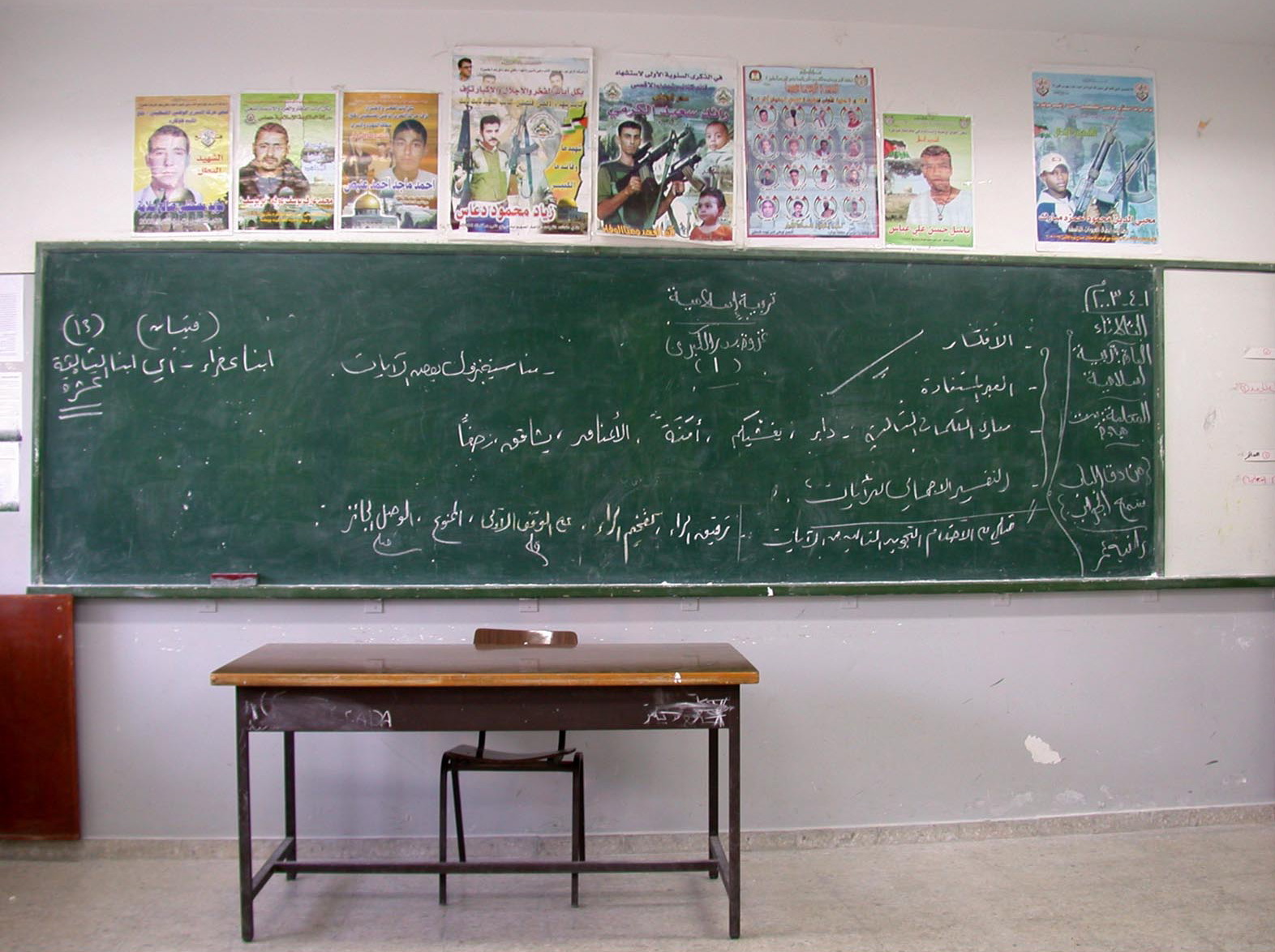
Posters of suicide bombers hang in Palestinian classroom in Tul Karem. Photo: IDF/Flickr

The conclusion the authors draw from this striking and seemingly obvious discrepancy? Faced by this issue, the report simply states that “the very small number of photographs in the Palestinian books rated as providing information about the other makes the percentage breakdown of little meaning.” While the sample size might make the “percentage breakdown” of little statistical value, the fact remains that when Palestinian students opens their textbooks—even to pages that reference places in Israel—they almost never see a photo of an Israeli, and never humanize Israelis.

The study’s methodology is also deeply flawed. Indeed, the Palestinian texts chosen are by far the most innocuous the researchers could possibly find. Nir Boms and Yaell Teff from the Institute for Monitoring Peace and Cultural Tolerance in School Education (IMPACT-SE), an NGO that studies attitudes toward peace and “the other” in school textbooks throughout the Middle East, point this out in devastating fashion. Victims of Our Own Narratives? they claim, simply ignores passages from Palestinian textbooks that are breathtaking in the danger they represent in an educational context, citing texts like the following, found in standard Palestinian textbooks:

God’s Messenger said: “The Hour of Resurrection will not come until the Muslims fight the Jews. The Muslims will kill them, and when a Jew would hide behind a rock or a tree the rock or the tree would say: O Muslim, O worshipper of God! There is a Jew behind me; come and kill him!”

A recent report published by IMPACT-SE documents more examples: A sixth-grade Palestinian textbook says, “The Messenger of God [Muhammad] ordered to Zayd Ibn Thabit to learn the language of the Jews in order to be safe from their cheating.” An eighth-grade textbook says, “Your enemies killed your children, split open your women’s bellies, held your revered elderly men by the beard, and led them to the death pits”—a quotation dismissed by the committee because it did not explicitly mention Jews or Israel. Yet another textbook, for grade 12, says, “By your life! How come that snakes invade us and we [still] observe a protection covenant [dhimma] which respects commitments?”

Perhaps more than any other part of the Victims report, this section covering the portrayal of religion seems the most biased. In these cases, the authors not only ignore passages from Palestinian textbooks that are hostile toward “the other,” they ignore cases of outright anti-Semitism, hatred, and incitement to violence. 


A second methodological point concerns the choice of school systems included in the study. The report goes a long way to include analysis of ultra-Orthodox, or Haredi, school texts in its breakdown of the situation. Unsurprisingly, it finds that Haredi textbooks are more problematic than their secular counterparts. But bizarrely, the report itself states that the Haredi system is independent of the Israeli public school system and its textbooks are “not subject to approval by the Ministry of Education.” This raises the question of why the authors made Haredi textbooks a key part of the report. 


The study portrays the Haredi system as essentially equal to that of the mainstream Israeli system and the Palestinian system. In all charts and discussions, the three systems appear next to each other and appear to be granted equal weight and importance. But, as the report’s authors are surely aware, the Haredi school system accounts for—at most—a quarter of Israeli Jewish students. Haredi textbooks, in other words, are certainly worthy of analysis, but they tell us next to nothing about mainstream Israeli attitudes toward Palestinians. 


This, however, is not the biggest problem with the discussion. For while the report places such importance on the Haredi system, it also completely ignores the Hamas-run school system in Gaza. Though these schools comprise a small number of Palestinian schools—and less than the percentage of ultra-Orthodox schools in Israel—they must merit analysis. In other words, an extreme religious school system in Israel is given equal standing with the secular majority, while a more extreme (and much more violent) religious school system on the Palestinian side is effectively erased. 


One of the main findings of the report is, indeed, that Israel’s state school system textbooks are in fact less problematic than Palestinian texts. “While present and problematic in all school systems, the negative presentation of the other, the positive non-critical presentation of the self and the absence of images and information about the other are more pronounced in the Israeli ultra-Orthodox and Palestinian school books than in the Israeli state school books,” both the report and its press release state. By including the ultra-Orthodox school system in their conclusion, the authors set out to create the semblance of an equivalence between Israeli and Palestinian textbooks even though their research shows something entirely different.

The body of the report deals with Israeli and Palestinian textbooks. The authors describe their work as first attempting to evaluate “the ways in which the ‘other’ is portrayed” through such things as “descriptions of the other” and “characterization of the acts of the other.” The results are presented under the heading: “Major Common Problem: Consistent Negative Portrayal of the ‘Other.’” 
The heading obviously indicates that both sides share the problem in “common.” But it’s unclear precisely why the authors chose this title, since their own data completely disproves it. The report itself states that “the other” is portrayed in positive or neutral terms in 51 percent of Israeli textbooks, but only 16 percent of Palestinian textbooks. “The other” is portrayed in negative terms in 49 percent of Israeli textbooks, but a stunning 84 percent of Palestinian texts.  

The section on “Characterization of the Acts of the Other” reveals almost the same results. 48 percent of Israeli textbooks characterize Palestinian “acts” in “very positive (superior), positive, or neutral” terms. In Palestinian texts, only 12 percent of cases studied portray Israeli “acts” in a positive light. When it comes to portraying acts as negative, Israeli texts are roughly balanced against those presenting positive, with 51 percent of Israeli textbooks showing acts as negative. On the Palestinian side, the negative characterization of Israeli acts is, once again, overwhelming with 87 percent of Palestinian textbooks presenting them in a negative light—according to the study. In almost 9 out of 10 cases, that is, Palestinian textbooks depict Israeli actions in a negative way. 


It’s not just the raw numbers but the nature of the examples that is disturbing. One Israeli textbook recounts the 1941 “Farhud” pogrom against Iraqi Jews in the following way: “On the holiday of Shavuot, Arabs attacked Jews and murdered them, including women and children…. The slaughter of the Jews of Baghdad continued for two days without interruption.” Compare this relatively dry and objective description with a Palestinian textbook’s almost hysterical and demagogic description of Israel’s War of Independence (the emphasis is mine): “The Palestine war ended with a disaster of which history had not seen the like, and Zionist gangs usurped Palestine and displaced its people from their cities, villages, land, and houses, and founded the state of Israel.” 


The report also cites positive depictions of Arabs in Israeli textbooks, even in the context of anti-Jewish actions. One textbook writes the following about the massacre of the Jews of Hebron in 1929, “If not for the brave stand of a British police officer and moderate Arabs, who physically defended their Jewish neighbors, the slaughter would have been more awful.” Another writes of an Arab man who helped an IDF soldier, “‘I saw it as my obligation as a Muslim Arab to offer help to an Israeli soldier injured in an accident’, said Abdullah Yusef Yunes… who offered help and drove an Israeli soldier in his vehicle.” 


In contrast, the report is able to find only one example from a Palestinian textbook of Jews or Jewish acts portrayed in a positive manner and—as you’ll see—the case is somewhat lacking in historical realism:

The following divine books: 1 – “The messages of Abraham (peace be upon him) and Moses call for belief in God Almighty, worshipping Him, and following noble morals.” 2 – The Torah: Was revealed to Moses (peace be upon him) to guide the children of Israel. 3 – The Zabour: Was revealed to David (peace be upon him) with sermons and guidance for the children of Israel. 4 – The Gospel: Was revealed to Jesus (peace be upon him) to guide the children of Israel, and to reaffirm what Moses (peace be upon him) had brought.

As should be obvious, this example is completely meaningless. It is purely religious in nature; it has no relation to the Israeli-Palestinian conflict; in fact, it says nothing whatsoever about Israelis or any modern-day Jews at all. In contrast, Israeli textbooks depict concrete actions taken by real Palestinians within the context of the conflict. 


The conclusion to this section is thus very strange. It claims that “positive characterizations of Arabs or their actions in Israeli state books typically refer to individuals rather than to Arabs as a whole or as a nation.” Yet it fails to mention that the only citation from a Palestinian textbook refers to neither individuals nor a nation in the modern sense, but only to ancient religious precepts.

The report correctly identifies the issue of self-criticism as one critical to understanding an education system, tacitly acknowledging the fact that a capacity for self-criticism is essential to any free society, and equally essential to ending a long-running conflict. Recognizing its own sins allows a society to see the humanity and suffering of “the other,” and thus take concrete steps toward reconciliation.

In the study’s analysis, collective Israeli actions are described in Israeli textbooks as very negative (“evil”) five percent of the time—not a high degree by any standard. But Palestinian texts describe collective Palestinian actions this way in zero percent of their textbooks. 29 percent of Israeli textbooks describe Israeli actions as negative or neutral. Only 12 percent of Palestinian textbooks do so with their society. 54 percent of Israeli textbooks describe their society’s actions as positive or very positive. Fully 85 percent of Palestinian textbooks do the same. In other words, Israeli textbooks describe their collective actions positively just over half the time. (And this, it should be noted, is in a country that is still at war.) 


Once again, when it comes to cases of self-criticism the report chooses examples from textbooks that appear blatantly weighted in favor of the Palestinians. It cites seven examples from Israeli textbooks, including, among others, the portrayal of the 1946 King David Hotel bombing and the killings at Deir Yassin during the War of Independence. Yet it gives only one example of self-criticism from a Palestinian textbook, and again, it’s strikingly out of context. It refers to the 7th century Islamic ruler Omar ibn Al Khattab:

Omar’s policy with his subjects is an example illustrating how careful Islam is to guarantee subjects’ rights and provide them with a dignified life whatever their religion. When Omar saw an elderly Jew begging because of his poverty and need, he (may God be pleased with him) told him: “We were unjust to you, we took the jizya (poll tax) from you as a young man, and then we abandoned you in your old age.” Omar ordered that he and those like him be spent for out of Islamic charity money.

As before, the examples taken from Israeli textbooks deal with concrete actions taken by the modern State of Israel in the current Israeli-Palestinian conflict. In contrast, the Palestinian text deals with actions taken approximately 1,300 years ago by a Muslim ruler who was not a Palestinian. (Omar hailed from Mecca.) It’s impossible to see how this is related in any way to the Israeli-Palestinian conflict, let alone the Palestinians’ portrayal of their own society. Indeed, the reader can be forgiven for thinking that, if better examples had been found, they would have been cited instead. And if this is the best the Palestinian education system can do, one would think the authors of the report would note it. But they don’t. 


The findings on overall self-image is equally telling. The research shows that Palestinian textbooks portray Palestinians as victims 66 percent of the time and only 2 percent as perpetrators. Israel, in contrast, portrays itself as a community of victims only 35 percent of the time and five times more than the Palestinians, at 10 percent of the time, as perpetrators. Judging by these results, it’s hard to understand how Israelis can be described, in the words of the study’s own title, as “victims of their own narrative.”

The report’s attitude is also evident in its analysis of the textbooks’ treatment of religion. The data presented indicate that descriptions of Islam occur in 50 percent of Israeli textbooks, whereas Judaism appears in only 15 percent of Palestinian textbooks. And the examples are again very telling. One Israeli textbook notes the diversity of religions who regard Jerusalem as sacred, and does so in the present tense:
In Jerusalem, a city which is considered holy in all three religions, there are praying buildings [sic] with domes—of Jews, Muslims and Christians. Among the buildings with domes in the Old City: the Dome of the Rock, the Al-Aqsa mosque of the Muslims, the Church of the Holy Sepulcher of the Christians, the “Horva” Synagogue of Jews.

In the context of recognizing “the other” and advancing the cause of peace, the Israeli text’s recognition of the sanctity of Jerusalem—one of the politically hottest and emotionally most stirring issues for Israelis— to non-Jews is, to put it mildly, significant. It’s strong enough a point to think that a presentation of Jerusalem in this way could even pave the way for compromise on sovereignty over the Old City. 


There is no parallel Palestinian text presented by the study. Of the textbooks surveyed, there was no mention, not even in passing, that Jews regard the Temple Mount as sacred. Instead, this is one of the texts cited by the study as proof of Palestinian presentation of religious understanding regarding the conflict: “The Jews kept Saturdays’ sanctity and they made it a day for rest and prayer, and they forbid all the work in it, even the work for good, and by healing the patients on Saturday Jesus taught us that the work of goodness is mandatory all the days even in Sunday.” In contrast to the Israeli text, this has no connection to the conflict and no national or territorial meaning. 


When one puts the media hype aside and examines theVictims study in full, one almost gets the feeling that the authors didn’t read their own report. In the face of overwhelming data, collected by the authors themselves, the report reaches the baffling conclusion that both sides embrace “unilateral and exclusive national narratives” and that “both Israeli and Palestinian school books forcefully and consistently establish distinct unilateral and opposing narratives.” Throughout, they claim, the textbooks show “a lack of recognition of the presence and absence of information about the other.” Contradicted by report’s own data, these conclusions are simply unsupportable. 
 

There is a clear and commendable reason that the U.S. State Department funded a study about textbooks used in schools 6,000 miles away. The idea that open-minded and tolerant education can advance peace between Israel and the Palestinians in the long term is both inspiring and realizable. In this sense, the study itself is a very positive step. But the analysis and interpretation of the findings, and the way they were presented to the public, were a distortion of the truth. In this the authors of the report failed to meet the State Department’s most important goal—promoting and advancing peace. 


woensdag 22 mei 2013

Bij 65 jaar Israel alleen aandacht voor 'catastrofe' Palestina (IPI)

 
Hebron 15 mei 2013
 

Door Tjalling.

Afgelopen 14 mei was het precies 65 jaar geleden dat Israël zijn onafhankelijkheid uitriep. In Israël zelf werd haar 65e verjaardag al in april gevierd, conform de Hebreeuwse kalender, maar dat wekte hier vrijwel geen aandacht in de media. Op 15 mei hielden de Palestijnen hun jaarlijke 'Nakba Dag' met enkele demonstraties en kleinere schermutselingen met het Israelische leger. Normaal gesproken niet echt nieuwswaardig, maar toch voor media zoals de Telegraaf, het AD , het Parool , Trouw en het Reformatorisch Dagblad aanleiding om een bericht te plaatsen dat de aandacht weer eens vestigt op het Palestijnse leed dat door de stichting van Israël zou zijn veroorzaakt. Letterlijk meldt het van ANP en andere persbureaus overgenomen bericht: "…toen in 1948 de stichting van Israël ervoor zorgde dat Palestijnen hun huis moesten verlaten en vluchteling werden."

De Palestijnse vluchtelingenstroom was echter al maanden eerder op gang gekomen, en was niet het gevolg van de stichting van Israël maar van een van Arabische zijde gestarte burgeroorlog, en na 15 mei de aanval door een coalitie van de Arabische buurlanden. Beide hadden tot doel de stichting van de Joodse staat te verhinderen.

Als die aanval verkeerd zou hebben uitgepakt voor Israël, dan zouden de gevolgen daarvan desastreus geweest zijn voor de 600.000 Joden die toen al in Palestina woonden. De voorzitter van de Arabische Liga, Abdul Rahman Hassan Azzam, die een week voor de onafhankelijkheidsverklaring aan Britse diplomaten had verklaard 'de Joden de zee in te drijven' zei de dag voor de aanval zelf publiekelijk: "Het zal een oorlog zijn van uitroeiing en van reusachtige slachting, waarover gesproken zal worden zoals over de Mongoolse bloedbaden en de kruistochten." De Moefti van Jeruzalem, Amin al-Hoesseini, tijdens de Tweede Wereldoorlog een bondgenoot van Hitler, deed er nog een schepje bovenop: "Ik verklaar een heilige oorlog, mijn moslim broeders! Vermoordt alle Joden! Vermoordt hen allen!"

De oorlog leidde niet alleen tot de vlucht en verdrijving van ongeveer 711.000 Palestijnen (waarvan er later 30.000 tot 90.000 naar Israël terugkeerden), maar ook tot de verdrijving van alle Joden uit de oude stad van Jeruzalem. Als gevolg van deze oorlog en de Arabische anti-Joodse maatregelen moesten in de jaren erna tevens meer dan 800.000 Joden uit Arabische landen vluchten, meestal met achterlating van al hun bezittingen, waarmee er een einde kwam aan vele eeuwenoude Joodse gemeenschappen.

Israëls onafhankelijkheidsoorlog kostte meer dan 6.000 Joden het leven, waarvan eenderde overlevenden van de Holocaust waren. Dat was minder dan het aantal Arabische doden, maar meer dan het aantal Palestijnse doden (naar schatting 3.000), en naar rato veel meer, namelijk 1% van de toenmalige Joodse bevolking in Israël.

In vrijwel alle berichtgeving naar aanleiding van de onafhankelijkheid van Israël en de daaropvolgende oorlog, ontbreekt deze context en ontbreekt vooral het leed aan Joodse zijde.

Mondiaal Nieuws

In Mondiaal Nieuws verscheen op 15 mei een opinie artikel van Brigitte Herremans, medewerkster Midden-Oosten van Broederlijk Delen en Pax Christi Vlaanderen. Dit zijn twee katholieke Belgische zogenaamde vredes- en ontwikkelingsorganisaties, die evenals de Nederlandse Oxfam Novib en United Civilians for Peace erg pro-Palestijns geörienteerd zijn.

In het artikel, dat slechts oog heeft voor de Palestijnse kant, wordt VN-resolutie 194 genoemd, die onder meer Israël oproept om de vluchtelingen te laten terugkeren. Deze resolutie werd van Arabische zijde decennialang afgewezen, omdat die impliciet Israël erkent en tot een vredesregeling oproept, maar wordt tegenwoordig graag aangehaald omdat hij naar Arabische interpretatie een 'recht op terugkeer' voor de Palestijnse vluchtelingen zou behelsen (wat echter niet het geval is). De resolutie gaat vooral over een destijds ingestelde verzoeningscommissie en roept verder op Jeruzalem onder direct VN-bestuur te plaatsen, een streven waar geen der partijen ooit mee heeft willen instemmen maar die formeel nog steeds het VN-standpunt is.

Broederlijk Delen en Pax Christi benadrukken dat een oplossing voor de Palestijnse vluchtelingenkwestie cruciaal is. Maar waarin die oplossing dan zou moeten worden gezocht en gevonden wordt niet genoemd. Makkelijk zal het zeker niet gaan. Inmiddels is het aantal Palestijnse `vluchtelingen' volgens de Palestijnse vluchtelingen organisatie UNRWA opgelopen tot meer dan 4 miljoen. Het is voor Israël een onmogelijke opgave al deze mensen te moeten huisvesten. Bovendien hanteert de UNRWA een geheel andere definitie voor vluchteling dan de UNHCR, de VN-organisatie voor alle andere vluchtelingen ter wereld. Volgens die algemene definitie zou het aantal Palestijnse vluchtelingen, als direct gevolg van de oorlog in 1948, nog maar 100.000 tot hoogstens 200.000 personen zijn, allen bejaarden. Niet alleen Mondiaal Nieuws, ook de zogenaamde mainstream media leggen dit verschil in definitie van vluchteling tussen de UNHCR en de UNRWA niet uit.

'Israël drijft de Bedoeïen in de hoek', klaagt Herremans enkele alinea's verder. Deze klacht wordt in elk geval ontkracht door een artikel van het Franse persbureau AFP over de hoogste bedoeïenen spoorzoeker in het Israëlische leger, kolonel Magdi Mazarib. Hij zegt daarin helder 'dat in vergelijking met de buurlanden, de status en positie van de Arabieren in Israël beter is'. Het artikel uit het AFP werd trouwens ook doorgegeven door het Arabische persbureau Al Arabya.

Herremans merkt ook op dat de hedendaagse situatie van de Palestijnse burgers in Israël allesbehalve ideaal zou zijn. Zij baseert zich daarbij enkel op Adalah, een organisatie die opkomt voor de belangen van Arabieren in Israel en partnerorganisatie van Broederlijk Delen. Feitelijk heeft ze het steeds over de bedoeïenen in de Negev woestijn, met als voorbeeld Al-Araqib, waar al jaren rechtszaken om worden gevoerd. De staat Israël heeft voor de rechtbank overtuigend aangetoond, onder meer met luchtfoto's, dat vestigingen van de bedoeïenen hier van recente datum zijn en zij geen wettelijke claim om dit gebied kunnen doen gelden, zodat deze nederzetting inmiddels vele malen is ontruimd en door de bedoeïenen weer opgebouwd.

Conclusie

In het verre verleden is wellicht teveel eenzijdige aandacht uitgegaan naar de Israëlische kant van het MO-conflict. Echter de laatste decennia is de balans pas goed uit evenwicht geslagen door vrijwel alleen aan Palestijns leed van vroeger en nu aandacht te schenken. De berichtgeving over, of liever naar aanleiding(!) van 65 jaar onafhankelijkheid van Israël is als gevolg daarvan weer eens onvolledig en eenzijdig. Het artikel van Herremans toont de eenzijdigheid aan bij ideële organisaties die vrede en rechtvaardigheid zeggen na te streven maar alleen oog hebben voor Palestijnse claims. Reguliere media hebben deze tendens helaas grotendeels overgenomen in hun berichtgeving.


Bronnen:


Israel wil ondanks Duitse concurrentie meedingen naar zetel Veiligheidsraad 2019

 
Sinds de jaren '80 zit Duitsland 2 jaar van elke 8 jaar in de Veiligheidsraad van de VN, gekozen via een ingewikkeld systeem van roulering per regionaal blok. In 2002 werd ook Israel tot het Europese-en-overige blok toegelaten, nadat het al ruim 50 jaar door het Aziatische blok geweigerd was.
In 2005 kondigde Israel aan te willen kandideren voor de Veiligheidsraad in 2019, de eerste vrije plaats voor het Europese blok. Helaas is ook Duitsland dan weer aan zijn 8-jaarlijkse deelname toe, en het wil niet voor Israel wijken, mede omdat de kans dat Israel wordt gekozen niet bijster groot is. 128 Leden in de algemene vergadering moeten immers voor stemmen, en zoveel vrienden heeft Israel niet, in tegenstelling tot de vele dictaturen die elkaar steunen.
 
 
Wouter
______________
 

J'lem to vie for 2019 UNSC seat despite Berlin bid

http://www.jpost.com/Diplomacy-and-Politics/Jlem-to-vie-for-2019-UNSC-seat-despite-Berlin-bid-313668


By HERB KEINON

05/20/2013 00:47


Westerwelle’s response "did not leave us optimistic" say diplomatic officials.


Israel will go ahead with its candidacy for an unprecedented seat on the UN Security Council in 2019 despite Germany’s determination to run against it, diplomatic officials told The Jerusalem Post on Sunday.

Both Prime Minister Binyamin Netanyahu and Justice Minister Tzipi Livni brought up in separate meetings on Friday with visiting German Foreign Minister Guido Westerwelle the announcement by Berlin that it will seek a seat on the council in 2019, badly weakening Israel’s chances to win a first-ever seat on the Security Council.

Westerwelle’s response, according to diplomatic officials, “did not leave us optimistic.”

According to the officials, Westerwelle said that Germany would be glad to support an Israeli bid to sit on the council if there was a chance that it could garner the 128 seats in the General Assembly necessary to win a seat. But since Berlin considered those chances slim, it decided to put forward its candidacy.

Besides, Westerwelle said, Germany’s policy is to sit on the Security Council every eight years. It last served on the council in 2011.

Candidates for one of the 10 non-permanent seats on the council – the US, Russia, China, Britain and France are permanent members – are allocated according to regional blocs. As of 2000, Israel became a member of the 28-strong Western European and Others (WEOG) regional group, a move that opened the door to Israel’s possible participation in the Security Council.

Israel is the only country in the region – and one of the few countries in the UN – that has never sat on the body. In September 2005, soon after Israel withdrew from the Gaza Strip and then-prime minister Ariel Sharon was warmly received in the UN, then-foreign minister Silvan Shalom announced that Israel would vie for a spot in 2019, the next date in which both WEOG slots had not already been claimed – a situation in UN jargon termed a “clean slate.” Until Germany announced its candidacy, only Israel and Belgium were vying for the two slots.

Westerwelle said that it was highly unlikely that no other country from WEOG would vie for a spot in 2019, and it was better for Israel that Germany bid for the slot, rather than a less friendly country.

Despite Westerwelle’s position, Jerusalem does not believe that the “door is closed” on the matter, and that following Germany’s September federal elections and the possibility of a change of some key personalities in the decision-making apparatus in Berlin, there could be a change of heart. In any event, one official said, 2019 is still a long way off.

Either way, the official added, Israel would pursue its candidacy because running for a seat on the Security Council is an important act in Jerusalem’s efforts to fight delegitimization and illustrate Israel’s “normalcy.”


Duitsland en Israel concurreren voor zetel in VN Veiligheidsraad


Dit nieuws is me ontgaan vorige week. Het lijkt wat ongelukkig dat Duitsland zijn kandidatuur bekend maakte net nu Israel – voor het eerst – kans zou maken op een zetel in de Veiligheidsraad. Israel is een van de zeer weinige landen die nog nooit in dit orgaan zitting hebben gehad, omdat dit altijd is tegengehouden door de Arabische en islamitische landen. Tot 2002 was Israel van geen enkel regionaal blok lid, omdat het Aziatische blok Israels lidmaatschap weigerde. In 2002 werd Israel daarom, onder voorwaarden, tot het Europese en Westerse blok toegelaten. Voor Israel is het van groot belang om ook een keer zitting te nemen in de Veiligheidsraad, niet alleen omdat het Midden-Oosten conflict daar regelmatig aan de orde komt, maar ook omdat het daarmee kan laten zien een ‘gewoon’ land te zijn.

The official said that while Germany was very sensitive to Israel’s security needs, “there is not the same kind of attention and sensitivity to Israel’s battle for international legitimacy.”

A seat on the Security Council, or even being a serious candidate for such a seat – especially at a time when the Boycott, Divestment and Sanctions movement is trying to delegitimize Israel – is seen in Jerusalem as important because it sends the message that Israel is a “normal country like all others,” the official said.

Duitsland op zijn beurt probeert al een tijdje tevergeefs om een permanente zetel in de Veiligheidsraad te bemachtigen. Het is de derde netto betaler aan de VN na de VS en Japan. Zolang dat niet lukt wil het in ieder geval iedere 8 jaar een roulerende zetel bemachtigen.


De kans dat Israel, ook zonder Duitse kandidatuur, de zetel zou bemachtigen lijkt niet bijzonder groot, daar dit een tweederde meerderheid in de Algemene Vergadering vereist. Het is bekend dat om het even welke anti-Israel resolutie daar op een automatische meerderheid kan rekenen. Israel is echter al met enkele staten in onderhandeling over eventuele steun in ruil voor een Israelische stem voor hun kandidatuur elders.  

It is believed that one of the reasons Germany went ahead and declared its candidacy, even though Israel was in the running, was because it did not feel that Israel would in the end succeed to muster the 128 votes it needed to be elected

Misschien dat Westerse landen zich hier wat meer hard voor zouden moeten maken? Het is natuurlijk eigenlijk schandalig dat talloze mensenrechtenschenders en dictaturen in de Veiligheidsraad hebben gezeten, en Israel er na meer dan 70 jaar niet een keer een zetel zou kunnen bemachtigen. 


RP

---------


Germany and Israel both up for UN Security Council

http://www.jpost.com/Diplomacy-and-Politics/Germany-and-Israel-both-up-for-UN-Security-Council-312973

By HERB KEINON

05/13/2013 06:04


Matter to be raised when German FM Westerwelle arrives in Israel, where he will meet with both Israeli and Palestinian leaders.


Jerusalem is miffed at Germany’s decision to vie for a seat on the UN Security Council in 2019, a move which would weaken Israel’s already distant chances of sitting on that influential body for the first time, The Jerusalem Post has learned.

Israel’s and Germany’s respective candidacies will be raised when Foreign Minister Guido Westerwelle arrives in Israel on Friday.

Related:   Prosor calls on UN Security Council to condemn Gaza rockets

On Saturday he will visit the Palestinian Authority.

One diplomatic official said news that Germany would be vying with Bel- gium and Israel for one of two slots reserved for countries from the UN’s Western European and Others (WEOG) regional grouping was received with “discomfort” in Israel.

The official said that while Germany was very sensitive to Israel’s security needs, “there is not the same kind of attention and sensitivity to Israel’s battle for international legitimacy.”

A seat on the Security Council, or even being a serious candidate for such a seat – especially at a time when the Boycott, Divestment and Sanctions movement is trying to delegitimize Israel – is seen in Jerusalem as important because it sends the message that Israel is a “normal country like all others,” the official said.

While the official denied that the issue represented any kind of diplomatic crisis with Berlin, he did say Israel intended to enter into a dialogue with Germany over this matter and convey the importance this two-year membership would have in cementing Israel’s legitimacy at a time when that legitimacy is under attack.

Germany, meanwhile, is interested in eventually securing a permanent seat on the Security Council, is the third-largest contributor to the UN after the US and Japan, and has had a policy over nearly the past three decades of being on the Security Council every eight years. Germany finished its last term on the council in 2011.

One German official said that “active support for the UN has always been a foreign policy priority for Ger- many. This includes regular German applications for one of the non-permanent seats in the UN Security Council, and will be continued.”

The official added that, “as we have proven on so many occasions, Germany always strives to coordinate closely with Israel.”

While Israel began the process of campaigning for the 2019-2020 slot as early as 2005, Germany only began recently because under UN regulations, a country can only declare its candidacy for one of the 10 non-permanent slots after it completes its previous term on the council. Israel was informed at the highest levels of the German decision before it was made public.

Candidates for one of the non-permanent seats on the council – the US, Russia, China, Britain and France are permanent members – are allocated according to regional blocs. As of 2000, Israel became a member of the 28-strong WEOG regional group, a move that opened the door to Israel’s possible participation in the Security Council.

Israel is the only country in the region – and one of the few countries in the UN – that has never sat on the Security Council, a body that historically has had a tremendous impact on Israel and the region.

In September 2005, soon after Israel withdrew from the Gaza Strip and then- prime minister Ariel Sharon was warmly received in the UN, then-foreign minister Silvan Shalom announced that Israel would vie for a spot in 2019, the next date in which both WEOG slots had not already been claimed.

Until Germany announced its candidacy, only Israel and Belgium were vying for the two slots. This did not mean, however, that Israel’s candidacy was assured, since all candidates need to be approved by a two-thirds majority, or 128 countries, in the UN General Assembly – something that would present Israel with a considerable challenge.

Nonetheless, Israel, according to diplomatic sources, had been in conversation with a number of countries – including unnamed countries that would not naturally back an Israeli bid – where- by Israel would support their candidacy to a post important to them, if they would back Israel’s candidacy.

It is believed that one of the reasons Germany went ahead and declared its candidacy, even though Israel was in the running, was because it did not feel that Israel would in the end succeed to muster the 128 votes it needed to be elected

Mohammed Al Dura op Arabische postzegels

 
Ik heb geen idee hoevelen in Nederland zich nog de beelden herinneren van Mohammed Al-Dura, het Palestijnse jongetje dat aan het begin van de tweede intifada door Israelisch vuur zou zijn omgekomen.
In de Arabische wereld is het beeld iconografisch geworden als ware het een Palestijnse Anne Frank, en elk zichzelf respecterend Arabisch land heeft zijn beeltenis wel op een of meer postzegels gezet.
 
Sinds jaar en dag wordt betwijfeld of het jongetje wel door Israelische kogels werd getroffen, en of hij überhaupt wel omgekomen is, of dat het toch een Palestijnse hoax uit "Pallywood" is. Voor de Franse rechter zijn er jarenlang rechtszaken over gevoerd.
Onlangs verscheen een rapport van een Israelische onderzoekscommissie, waaruit blijkt dat de jongen inderdaad niet door Israelische soldaten werd getroffen en waarschijnlijk helemaal niet was omgekomen.
 
Na de kwestie Al-Dura volgden er nog vele mediaberichten waarin Israel ten onrechte van allerlei wreedheden werd beticht, en dat gaat door tot op de dag van vandaag.
 
Wouter
_____________
 

Arab stamps commemorating the Al Dura hoax

http://elderofziyon.blogspot.nl/2013/05/arab-stamps-commemorating-al-dura-hoax.html

Today, the Israeli government released a report saying that Mohamed Al Dura, the young boy who symbolized the second intifada for so many, was not killed by Israel and indeed was probably not killed at all.

Prime Minister Benjamin Netanyahu received today the report of the Government Review Committee on "The France 2 Al-Durrah Report, its Consequences and Implications." The report was presented by the Minister of International Affairs, Strategy and Intelligence Yuval Steinitz, in the presence of Director General of the Ministry of International Affairs and Strategy, Yossi Kuperwasser.

Prime Minister Netanyahu directed then Minister of Strategic Affairs Yaalon to set up the governmental review committee in September 2012. The purpose of the committee was to examine the Al-Durrah affair in light of the continued damage it has caused to Israel, and to formulate the Government of Israel's position with regards to it.

Prime Minister Benjamin Netanyahu: "It is important to focus on this incident – which has slandered Israel's reputation. This is a manifestation of the ongoing, mendacious campaign to delegitimize Israel. There is only one way to counter lies, and that is through the truth. Only the truth can prevail over lies."

Minister of International Affairs, Strategy and Intelligence Yuval Steinitz: " The Al-Durrah affair is a modern-day blood libel against the State of Israel, alongside other blood libels like the claims of an alleged massacre in Jenin. The France 2 report was utterly baseless."

The Al-Durrah affair has its origins in a media report first aired by the French public television channel France 2 on September 30, 2000. The report claimed to show the killing of a Palestinian boy, targeted along with his father, according to the report, by fire from an Israeli position. The story was quickly relayed worldwide by the international media, which repeated the report's claim. The report had the immediate effect of harming Israel's international standing and fanning the flames of terror and hate.

Since that day, the narrative spawned by the France 2 report has served as an inspiration and justification for terrorism, anti-Semitism, and the delegitimization of Israel. The echoes of the Al-Durrah report, both in terms of accusations against Israel and in terms of media reports adopted uncritically by the international media which are later revealed to be false or misleading, have continued to resonate in the media coverage of Israel's operations against terrorist organizations.


This news is only 13 years too late. 

The incompetence of the extraordinarily late Israeli response to this modern blood libel would be laughable if it wasn't so dangerous. 

One appendix of the report shows stamps issued in Arab countries playing up the hoax as a means of inciting the world against Israel, from Egypt, Iran, Iraq, Morocco and Tunisia:


They missed Jordan's stamp series:


And Sudan's:


And Yemen's:


And Saudi Arabia's:


And a second stamp from Morocco:


At least nine Muslim countries - including "moderate" countries like Jordan and Morocco -  commemorated a death that was nothing more than a hoax, for the sole purpose of inciting hundreds of millions of Muslims and Arabs against the Jewish state.

If you want to see all the Al Dura evidence yourself, this website has tons of materials, including videos and maps showing the impossibility of Israeli fire hitting the boy.


dinsdag 21 mei 2013

Geld ontwikkelingshulp en vredeseducatie USA komt terecht bij anti-Israel campagnes


Dit gebeurt helaas ook in Nederland, waar de regering via United Civilians for Peace en onwikkelingsorganisaties als Oxfam-Novib ook geld geeft aan eenzijdige anti-Israel agitatie. Het geld is bedoeld voor ontwikkelingssamenwerking of initiatieven om de situatie van Palestijnen te verbeteren, maar gaat naar het uitnodigen van rabiate anti-Israel sprekers zoals Ali Abunimah of Norman Finkelstein, naar eenzijdige rapporten vol onjuistheden en campagnes tegen Israel. 


RP

---------


Report: Anti-Israel NGOs receive US funding

http://www.ynetnews.com/articles/0,7340,L-4382579,00.html

Research institute says some Mideast organizations receiving grants from Washington 'demonize Israel, promote BDS campaigns targeting Israel'

Ynetnews

Published: 

05.21.13, 17:14 / Israel News

A report presented to members of Congress on Tuesday by Jerusalem-based research institute NGO Monitor shows that US Government funding of several political NGOs in the Palestinian Authority and Israel contradicts US policy, has a negative impact on the peace process, and lacks the independent oversight necessary to prevent abuses.


"Some of the NGO grantees conduct activities that sharply contradict program objectives and policies," said Professor Gerald M. Steinberg, president of NGO Monitor.


"The National Endowment for Democracy (NED), for instance, funded by the US Government, in turn funds political advocacy NGOs that demonize Israel and promote BDS (boycotts, divestment, and sanctions) campaigns targeting Israel. This activity is entirely inconsistent with US policy."


The reports mentions that one such organization is MIFTAH ($178,740 in 2007-2012), a Palestinian NGO involved in anti-Israel campaigns and anti-Semitism, including repetition of the infamous blood libel and allegations of "the slaughter of Palestinian children," according to Steinberg.


Another group, "Windows," received $750,000 in a three-year grant from the US Agency for International Development (USAID). It is described by the Agency as "a tool for Israeli and Palestinian participants to learn about each other." But according to NGO Monitor, Windows' Youth Media Program adopts a "Palestinian narrative of the conflict including highly offensive comparisons between Israel and Nazi Germany."


Steinberg said, "Obviously, USAID and NED do not endorse such views, but the funding is indicative of the lack of supervision and transparency in such grants. Self-reporting, without independent evaluation on such complex issues, violates the principles of good governance."


NGO Monitor urged US officials to conduct "detailed, professional and independent evaluations of NGO activity before grant allocation, during implementation, and at the conclusion of the grant cycle."


NGO Monitor said it recently received an assurance from US Ambassador to Israel Daniel Shapiro that "we have put in place greater policy oversight of grant-making decisions over the past few years."


Hakenkruisvlag in Palestijns dorp

 
Zelfs in Israel zijn al eens neo-nazi's opgepakt (kinderen van Russische immigranten die vanwege een Joodse verwantschap waren toegelaten). Onderstaande lijkt ook een provocatie van enkele extremisten, ditmaal blijkbaar van Arabische komaf. Hoewel Hitler en het nazisme zeker geen taboe zijn in de Arabische wereld (Mein Kampf en de Protocollen van de Wijzen van Zion zijn bestsellers), zijn uitspraken als "The Arabs no longer feel the need to hide their murderous tendencies" op zijn zachtst gezegd wat erg generaliserend.
 
Wouter
____________

Swastika flag flies over Palestinian village

The Tazpit News Agency has provided an image of a Nazi flag flying over the Palestinian village of Beit Ummar in the West Bank

by The Commentator on 20 May 2013 10:35

Israel's Tazpit News Agency this morning reported that hundreds of residents of the Gush Etzion area were "astounded" to find a Nazi flag flying next to a mosque in the Palestinian town of Beit Ummar. The Israel Defense Forces (IDF) were notified immediately, claims the report.

The flag, as can be seen from the image provided, was found by residents who were driving to Jerusalem on Monday morning. Reports suggest the flag had been up on the pole since "early morning hours". As of two hours ago, the flag remained.

Local resident Uri Arnon told Tazpit: "I felt we were going back 75 years, losing our hold on the land. The Arabs no longer feel the need to hide their murderous tendencies, announcing out loud that they wish to destroy us."

An IDF spokesman said that the flag was hung on an electrical line, and that they were wating to proffesionals to come and remove it.

Gush Etzion is a cluster of Israeli settlements south of Jerusalem in the West Bank. It consists of around 70,000 people.

Beit Ummar has a population of around 15,000 citizens and straddles Areas B and C, allowing for both Palestinian civil authority, but Israeli control in part.